Rigid FR-4 PCB Fabrication
FR-4 PCB Manufacturing With Material Decisions Made Before Release
PCBInsider builds FR-4 PCB manufacturing programs around the variables buyers actually need to control: Tg, copper weight, stackup, surface finish, impedance targets, and downstream assembly readiness.
FR-4 is the workhorse laminate for rigid circuit boards, but a generic "FR-4" note is not enough for a production RFQ. This page defines the material and fabrication decisions that prevent thermal, drilling, and assembly surprises after purchase order release.
Standard and High-Tg FR-4DFM Before LaminationTypical 3-7 Day Lead Time

FR-4
Tg, Copper, Stackup, Finish
Tg 130-180C
Standard and High-Tg FR-4
1-32 Layers
Project-Dependent Stackups
4/4 mil
Standard Trace / Space
100%
Electrical Test Coverage
Why FR-4 Specification Matters Before the RFQ
FR-4 PCB fabrication succeeds when material, stackup, drill, copper, finish, and assembly constraints are aligned before the supplier starts production. The cheapest quote is rarely useful if the material note leaves those choices undefined.
Tg Selection Before Release
FR-4 selection starts with thermal exposure, not a generic material label.
Stackup and Resin Planning
FR-4 multilayer builds depend on core, prepreg, copper weight, and dielectric thickness working together.
Copper Weight Matched to Current
Standard FR-4 boards usually run 0.5-2 oz copper, while higher current products need engineering review for heavier copper.
DFM Focused on FR-4 Failure Modes
The DFM review looks at annular ring margin, drill aspect ratio, copper balance, solder mask dam, routing clearance, and panel support.
Assembly-Ready Surface Finish
Surface finish is selected around assembly and shelf-life needs.
Inspection Linked to the Buying Risk
Electrical test, visual inspection, and documentation are matched to the order type.
FR-4 PCB Capability Snapshot
These parameters come from PCBInsider's published PCB manufacturing and capability pages, then narrowed to the FR-4 material family so buyers can quote the right service instead of a broad fabrication category.
| Service Focus | FR-4 PCB fabrication for prototype, NPI, and production builds |
|---|---|
| Material Family | Standard FR-4, high-Tg FR-4, halogen-free options by review |
| Typical Tg Range | Tg 130-140C standard; Tg 170-180C high-Tg where needed |
| Layer Count | 1-8 layers standard; up to 32 layers under advanced PCB capability |
| Copper Weight | 0.5-2 oz standard; heavier copper handled by engineering review |
| Min. Trace / Space | 4/4 mil standard; 2/2 mil advanced capability by review |
| Min. Mechanical Drill | 0.20 mm standard; smaller laser features on HDI programs |
| Board Thickness | 0.4-2.4 mm standard; 0.2-6.0 mm project-dependent range |
| Surface Finish | ENIG, lead-free HASL, HASL, OSP, hard gold by application |
| Impedance Control | +/-10% standard; +/-5% advanced where stackup supports it |
| Inspection | 100% electrical test with final visual inspection |
| Lead Time Signal | 3-7 business days for many standard FR-4 builds after DFM approval |
Capability Scope and Limits
Best Fit
FR-4 PCB manufacturing fits commercial controls, IoT hardware, power interfaces, medical electronics subassemblies, test fixtures, and most SMT-ready rigid.
Use High-Tg FR-4 When Heat Margin Is Tight
High-Tg FR-4 is the practical upgrade when lead-free reflow, dense copper, repeated rework, or operating temperature gives standard Tg material too little.
Do Not Force FR-4 Into RF or High-Heat Jobs
FR-4 is not the default answer for low-loss RF, extreme thermal cycling, or metal-backed heat spreading.
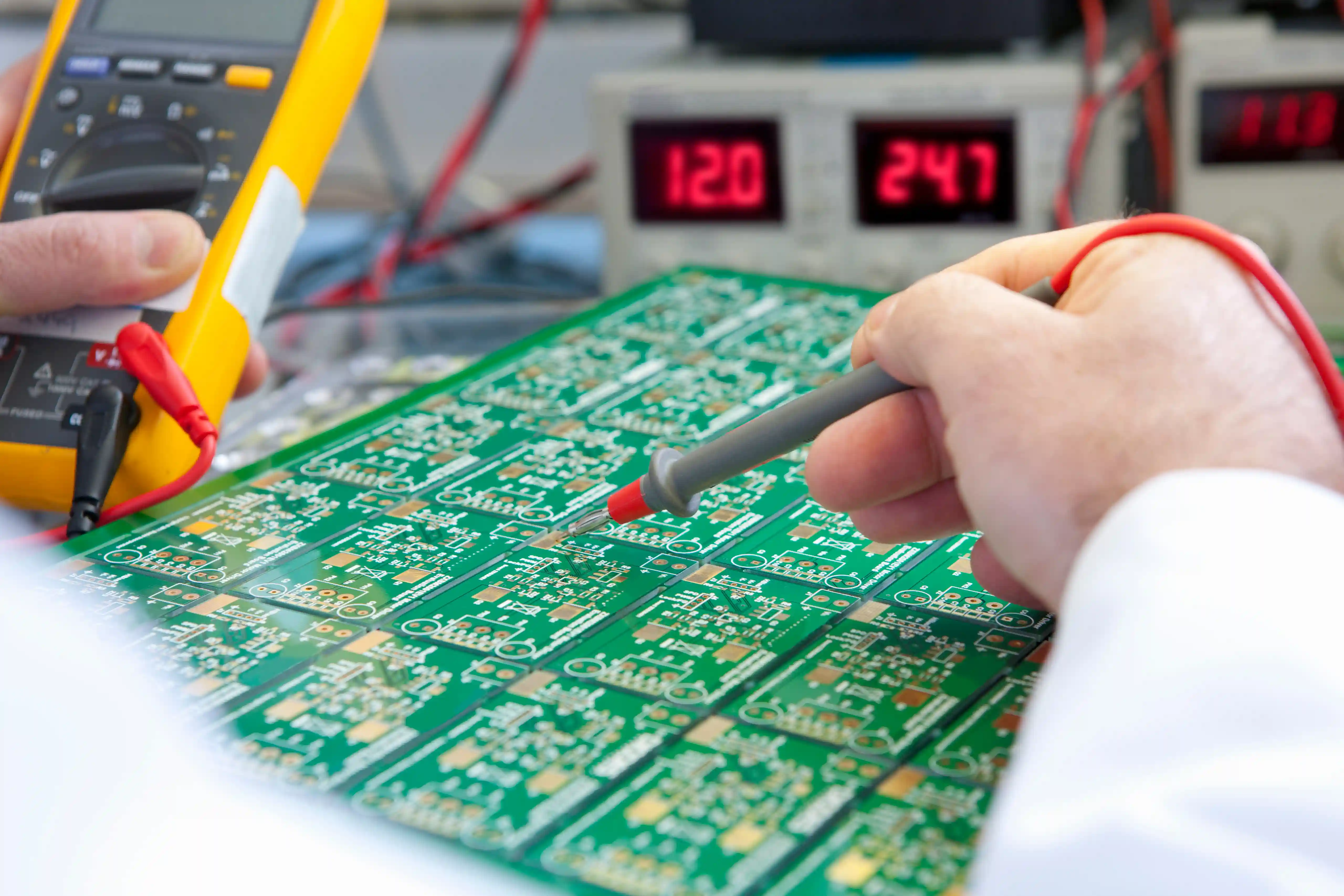
Electrical Test Is Part of Material Control
FR-4 material choice reduces risk only when the completed board is still verified for opens, shorts, and release condition. Finished panels should not move to assembly on material selection alone.
FR-4 Manufacturing Process
The process is built to remove ambiguity before production. A buyer should know which FR-4 grade, thickness, copper weight, finish, inspection path, and assembly handoff requirements are attached to the quote.
1
File Intake and Material Intent
We review Gerber or ODB++ data, NC drill files, board thickness, copper weight, quantity, finish, and the expected assembly process.
2
DFM and Stackup Review
The review checks trace and space, annular ring, hole size, solder mask clearance, copper balance, impedance targets, and finished thickness.
3
Fabrication and Surface Finish
Panels move through imaging, etching, drilling, plating, solder mask, legend, routing, and surface finish.
4
Electrical Test and Release
Finished FR-4 boards receive electrical test and final inspection before packing.
Standards and Material References
FR-4 PCB manufacturing touches material behavior, flame rating, design rules, and workmanship expectations. These public references help buyers align drawings with supplier discussions.
FR-4 describes the glass-reinforced epoxy laminate family commonly used for rigid printed circuit boards and notes the flame retardant material context behind the name.
IPC is the standards body buyers commonly reference for PCB design, fabrication, and assembly expectations, including IPC-6012 and IPC-A-600 style acceptance discussions.
Texas Instruments high-speed PCB layout guidance is useful when an FR-4 design needs controlled impedance, continuous return paths, and practical routing discipline before fabrication release.
Need FR-4 Boards Ready for Assembly?
Send Gerber or ODB++ data, NC drill files, board thickness, copper weight, finish, quantity, and any controlled impedance or high-Tg requirement. We can review whether standard FR-4 is enough or whether high-Tg, HDI, aluminum, or RF laminate should be considered.
Frequently Asked Questions
Practical answers for buyers comparing standard FR-4, high-Tg FR-4, and alternative PCB materials.
When should I choose high-Tg FR-4 instead of standard FR-4?
Choose high-Tg FR-4 when the board will see lead-free reflow, repeated rework, dense copper, or elevated operating temperature. Standard FR-4 is commonly Tg 130-140C, while high-Tg FR-4 is often Tg 170-180C. The extra margin helps reduce thermal stress risk, but it can add cost, so the decision should be tied to the assembly profile and product environment.
What files do you need to quote an FR-4 PCB order?
An FR-4 PCB quote needs Gerber or ODB++ files, NC drill data, board thickness, copper weight, surface finish, quantity, solder mask color, and delivery target. If the design has controlled impedance, include the target impedance values and layer intent. For assembly-ready orders, add the BOM, centroid file, and stencil notes so the FR-4 board can be reviewed as part of the full PCBA workflow.
I need 200 FR-4 boards for an industrial controller. Is that too small?
A 200-piece FR-4 PCB run is a normal low-volume or NPI quantity, not too small. The main question is whether the order is a first article build, a pilot run, or repeat production. For 200 boards, we usually recommend DFM review, electrical test, stable panelization, and the same material and finish you expect to use later so the build data remains useful.
Is FR-4 suitable for controlled impedance PCB designs?
FR-4 can support controlled impedance designs when the stackup, dielectric thickness, copper weight, and routing geometry are specified before fabrication. Standard tolerance is often around +/-10%, with tighter targets such as +/-5% needing stronger stackup control and engineering review. For very low-loss RF paths, FR-4 may not be the right material and a specialty laminate should be considered.
Should I use FR-4, aluminum PCB, or Rogers material for my board?
Use FR-4 for most rigid digital, control, power-interface, and mixed-signal boards where cost and availability matter. Use aluminum PCB when heat spreading is the dominant problem, such as LED or power modules. Use Rogers or another low-loss laminate when RF performance is the main risk. The wrong material choice can cost more than the laminate price through redesign, assembly defects, or failed validation.
How fast can standard FR-4 PCB manufacturing ship?
Many standard FR-4 PCB builds can move in about 3-7 business days after DFM approval, depending on layer count, copper weight, finish, and inspection requirements. Rush work is easier on simple 1-2 layer boards than on controlled-impedance multilayer designs. A complete RFQ package with Gerbers, drill data, quantity, finish, and material intent prevents quoting delays.
Related Services and Tools
Move from FR-4 material selection into broader fabrication, assembly, HDI decisions, or stackup preparation.
PCB Manufacturing
Broader rigid, HDI, flex, and specialty fabrication capability.
Explore4 Layer PCB Manufacturing
Stackup-focused fabrication when plane structure is the main concern.
ExplorePCB Assembly
SMT and through-hole support after the FR-4 boards are fabricated.
ExploreHDI PCB Manufacturing
Fine-feature builds when FR-4 fabrication moves into microvia work.
ExplorePCB Thickness Calculator
Check board thickness assumptions before releasing the RFQ package.
ExplorePCB Stackup Guide
Background on layer planning and dielectric choices before RFQ release.
Explore