Rogers PCB Materials Guide: Complete Series Comparison & Selection
Comprehensive guide to Rogers Corporation high-frequency PCB materials including RO4000, RO3000, RT/duroid, and TMM series. Compare properties and select the right laminate for your RF application.
Rogers Corporation has established itself as the premier supplier of high-frequency circuit board materials, with product lines spanning applications from cellular base stations to space-qualified satellite systems. Engineers designing RF and microwave circuits must understand the characteristics distinguishing various Rogers material families to select optimal substrates for their specific performance requirements, operating environments, and cost constraints. This guide provides a comprehensive overview of Rogers material series and practical guidance for material selection.
High-frequency circuit design places demanding requirements on PCB substrates that standard FR-4 materials cannot satisfy. Signal integrity at frequencies above a few hundred megahertz depends critically on dielectric constant stability, low loss tangent, and controlled impedance characteristics that FR-4's variable properties simply cannot provide. Rogers materials address these requirements through specialized formulations optimized for specific frequency ranges and application environments.
Rogers Corporation and High-Frequency Materials
Rogers Corporation has manufactured advanced materials for electronics applications since 1949, with high-frequency laminates representing a core product line developed over decades of research and manufacturing refinement. The company's Connecticut headquarters supports global operations serving telecommunications, aerospace, automotive, and industrial markets. Material development continues addressing emerging applications in 5G infrastructure, automotive radar, and satellite communications.
The fundamental value proposition of Rogers materials centers on controlled electrical properties that remain stable across frequency, temperature, and environmental exposure. Where FR-4 exhibits dielectric constant variations of plus or minus ten percent or more, Rogers materials typically specify tolerances of plus or minus one to two percent. This consistency enables engineers to design precision circuits with confidence that manufactured boards will meet performance specifications.
Rogers organizes its high-frequency laminate portfolio into several distinct product series, each targeting specific performance tiers and application requirements. Understanding the positioning and characteristics of each series helps engineers navigate material selection efficiently rather than evaluating dozens of individual material grades.
Understanding Key Material Properties
Dielectric constant quantifies the capacitance a material creates relative to air, directly affecting transmission line impedances and wavelength at operating frequencies. Lower dielectric constants enable wider traces at given impedance targets and shorter wavelengths that can reduce circuit dimensions at higher frequencies. Most Rogers materials range from 2.2 to 10.2 in dielectric constant, with selection depending on application requirements.
Loss tangent measures the fraction of electromagnetic energy converted to heat as signals propagate through the dielectric. Lower loss tangent translates directly to lower signal attenuation, higher receiver sensitivity, and improved transmitter efficiency. Rogers materials achieve loss tangents from 0.0009 to 0.004 depending on formulation, dramatically outperforming FR-4's typical 0.02 value.
Thermal conductivity determines how effectively the substrate conducts heat away from components and copper traces. Higher thermal conductivity helps manage temperature rise in power amplifier applications where significant RF energy dissipates as heat. Rogers materials range from 0.2 to 0.76 watts per meter-kelvin, with ceramic-filled formulations generally providing better thermal performance.
Coefficient of thermal expansion affects reliability during temperature cycling as mismatched expansion rates between substrate, copper, and solder create mechanical stresses. Z-axis expansion particularly impacts plated through-hole reliability. Different Rogers materials exhibit widely varying CTE characteristics suited to different reliability requirements.
RO4000 Series: Mainstream High-Frequency Material
The RO4000 series represents Rogers' highest-volume product line, offering excellent RF performance with processing characteristics similar to standard FR-4 materials. These glass-reinforced hydrocarbon ceramic laminates process using conventional PCB fabrication equipment without requiring the special handling that pure PTFE materials demand. This processing compatibility significantly reduces manufacturing costs compared to other high-frequency material families.
RO4003C provides an excellent entry point for RF designs, offering dielectric constant of 3.38 and loss tangent of 0.0027 at costs lower than most other Rogers materials. The material performs well through frequencies of 40 gigahertz and beyond, making it suitable for many 5G and radar applications. However, RO4003C lacks UL 94 V-0 flame rating, limiting its use in applications requiring formal flame retardancy certification.
RO4350B addresses the flame rating limitation while providing slightly different electrical properties with dielectric constant of 3.48 and loss tangent of 0.0037. The UL 94 V-0 certification makes RO4350B appropriate for telecommunications infrastructure, consumer electronics, and other applications where safety certifications matter. Enhanced thermal properties compared to RO4003C make this material popular for power amplifier circuits.
RO4835 optimizes loss characteristics for applications where signal attenuation must be minimized, achieving loss tangent of 0.0031 while maintaining UL 94 V-0 flame rating. This material suits demanding microwave applications requiring both low loss and safety certification.
RO4360 offers high dielectric constant of 6.15 enabling size reduction in filter and antenna applications where space constraints drive design priorities. The combination of higher dielectric constant with Rogers' characteristic property stability enables compact circuits without sacrificing performance consistency.
RO3000 Series: Ceramic-Filled PTFE Excellence
The RO3000 series employs ceramic-filled PTFE technology achieving the lowest loss characteristics in Rogers' commercial portfolio. These materials target the most demanding microwave and millimeter-wave applications where signal loss directly impacts system performance. The ceramic filler provides stable mechanical properties while PTFE delivers exceptional electrical performance.
RO3003 achieves loss tangent of 0.0013 at 10 gigahertz, approximately half the loss of RO4003C. Dielectric constant of 3.00 provides stable performance through frequencies exceeding 77 gigahertz, making RO3003 popular for automotive radar applications where the 77-79 gigahertz bands demand ultra-low-loss substrates. Commercial production volumes support competitive pricing for high-volume automotive applications.
RO3006 offers higher dielectric constant of 6.15 for size-constrained applications requiring ultra-low loss performance. Filter designers frequently specify this material for compact microwave filters where circuit size reduction justifies the premium pricing.
RO3010 provides the highest dielectric constant in the RO3000 family at 10.2, enabling maximum miniaturization for antenna feed networks and matching circuits. The ceramic loading required for this high dielectric constant maintains excellent thermal stability that some competing high-Dk materials cannot match.
Processing RO3000 materials requires more specialized handling than RO4000 series materials due to their PTFE content. Sodium etching or plasma treatment may be needed for proper copper adhesion. Manufacturing costs typically run higher than RO4000 series, making RO3000 materials appropriate primarily for applications where their superior loss characteristics provide essential performance benefits.
RT/duroid Series: Aerospace and Defense Grade
The RT/duroid family comprises pure PTFE and filled PTFE laminates developed for the most demanding aerospace, defense, and scientific applications. These materials undergo extensive qualification testing and provide traceability documentation supporting mission-critical applications. Cost premiums reflect both the specialized materials and comprehensive quality systems maintaining aerospace-grade reliability.
RT/duroid 5880 achieves the lowest loss available in the Rogers portfolio with loss tangent of 0.0009 at 10 gigahertz and dielectric constant of 2.20. The combination of ultra-low loss with very low dielectric constant makes this material ideal for millimeter-wave applications above 40 gigahertz where every fraction of a decibel matters. Space-qualified versions support satellite communication systems.
RT/duroid 5870 provides similar ultra-low-loss performance with slightly higher dielectric constant of 2.33, offering designers flexibility in impedance targeting. Both 5870 and 5880 exhibit excellent performance through frequencies exceeding 100 gigahertz for emerging applications in radar and communications.
RT/duroid 6002 offers a cost-effective PTFE option with dielectric constant of 2.94 and loss tangent of 0.0012. This material provides better thermal conductivity than the 5800 series while maintaining excellent high-frequency performance. Military and space applications frequently specify RT/duroid 6002 for its combination of performance and reliability.
RT/duroid 6006 targets filter and resonator applications with higher dielectric constant of 6.15, enabling compact circuit designs in demanding aerospace environments. The material maintains stability through wide temperature ranges and withstands the thermal extremes encountered in space and aviation applications.
RT/duroid processing requires specialized handling including sodium etching for copper adhesion and careful lamination procedures. Manufacturing costs significantly exceed RO4000 series materials, limiting RT/duroid use to applications where performance requirements justify the premium.
TMM Series: Thermoset Microwave Materials
The TMM series provides ceramic-filled thermoset materials combining excellent microwave properties with easier processing than PTFE-based alternatives. These materials suit demanding applications requiring high thermal conductivity and dimensional stability without the processing complexity of pure PTFE laminates.
TMM10i offers the highest dielectric constant in Rogers' commercial portfolio at 9.8, enabling maximum circuit miniaturization for antenna and filter applications. High thermal conductivity of 0.76 watts per meter-kelvin supports power handling requirements in compact designs. Low z-axis CTE of 20 parts per million per degree maintains reliability through thermal cycling.
TMM3, TMM4, and TMM6 provide dielectric constant options of 3.27, 4.5, and 6.0 respectively, enabling designers to select optimal electrical characteristics for specific impedance and size requirements. All TMM materials share excellent thermal and mechanical stability suited for demanding environments.
TMM materials process more easily than RT/duroid laminates while providing superior performance compared to RO4000 series materials in certain parameters. The thermoset chemistry enables good copper adhesion without sodium etching while maintaining low loss characteristics appropriate for microwave frequencies.
Material Selection by Frequency Range
Application frequency range provides the primary criterion for initial material selection, as different materials exhibit optimal performance in different frequency bands. Understanding where each material family excels helps narrow selection to appropriate candidates before considering secondary factors.
For frequencies below 5 gigahertz, RO4003C and RO4350B provide excellent performance at reasonable cost. Their processing compatibility with standard FR-4 fabrication keeps manufacturing costs manageable while delivering the dielectric stability high-frequency circuits require. Most commercial RF applications in this frequency range can achieve their performance targets with RO4000 series materials.
Applications operating between 5 and 20 gigahertz may benefit from RO3003's lower loss characteristics, particularly for receiver front-ends where sensitivity matters. RO4350B and RO4835 remain viable options when their loss levels satisfy application requirements, providing cost advantages over RO3000 materials.
Millimeter-wave applications above 20 gigahertz increasingly demand the ultra-low-loss characteristics of RT/duroid 5880 or RO3003. The 77 gigahertz automotive radar band specifically drives high-volume RO3003 consumption, while RT/duroid 5880 dominates space and defense applications where cost sensitivity is lower.
Material Selection by Application
5G infrastructure applications typically specify RO4350B for base station antennas and power amplifiers where its balance of performance, flame rating, and thermal properties suits the requirements. The massive infrastructure buildout has made RO4350B one of the highest-volume Rogers materials.
Automotive radar applications increasingly standardize on RO3003 for 77 gigahertz front-end modules where its ultra-low loss enables the detection range and resolution that advanced driver assistance systems require. Production volumes support competitive pricing that has made RO3003 viable for automotive applications despite its premium positioning.
Aerospace and defense applications frequently specify RT/duroid materials for their proven reliability records and space qualification heritage. Program managers selecting materials for military radar, satellite communications, or avionics systems often prefer RT/duroid despite cost premiums because its extensive flight heritage reduces qualification risk.
Test and measurement equipment designers frequently select RO4003C or RO4350B for calibration standards and test fixtures where consistent, well-characterized dielectric properties enable accurate measurements. The tight tolerances of Rogers materials help maintain calibration accuracy over time.
Manufacturing Considerations
RO4000 series materials process using standard FR-4 fabrication equipment and techniques, minimizing manufacturing complexity and cost. Mechanical drilling, conventional etching, and standard multilayer lamination all apply without special procedures. This processing compatibility represents a significant advantage for cost-sensitive applications.
RO3000 and RT/duroid materials require specialized processing due to their PTFE content. Sodium naphthenate or plasma treatment activates the PTFE surface for proper copper adhesion. These additional processing steps increase manufacturing costs and require fabricators experienced with PTFE materials. Not all PCB manufacturers can successfully process these materials.
Drilling PTFE materials requires attention to chip evacuation and feed rates that differ from FR-4 processing. Specialized drill bits and optimized drilling parameters prevent delamination and ensure clean hole quality. Laser drilling provides an alternative for blind and buried vias in high-density designs.
Multilayer construction using Rogers materials follows similar principles as FR-4 lamination with attention to specific temperature profiles and pressures appropriate for each material. RO4000 series materials laminate using conventional FR-4-compatible prepregs, while PTFE materials may require dedicated PTFE bonding films for optimal results.
Hybrid Stackup Strategies
Combining Rogers materials with FR-4 in hybrid stackups reduces overall costs while maintaining RF performance where needed. This approach places Rogers material on signal layers requiring controlled impedance and low loss while using less expensive FR-4 for power distribution and ground planes. Hybrid designs typically achieve thirty to forty percent material cost reduction compared to all-Rogers construction.
Proper hybrid stackup design routes high-frequency signals on Rogers cores rather than on prepreg layers. The signal sees primarily Rogers dielectric in the vertical dimension, maintaining electrical performance similar to all-Rogers construction. FR-4 layers handle power distribution and structural functions without affecting critical signal paths.
Material compatibility affects hybrid stackup feasibility. RO4000 series materials laminate well with FR-4-compatible prepregs, enabling straightforward hybrid construction. PTFE-based materials present greater challenges for hybrid construction due to different lamination requirements and potential adhesion issues at material interfaces.
Cost Optimization Strategies
Material thickness optimization minimizes Rogers content while maintaining required electrical performance. Using the minimum thickness satisfying impedance and structural requirements reduces material cost per board. Standard thickness options from stock minimize premium pricing for custom dimensions.
Panel utilization affects per-board material costs significantly for the smaller boards common in RF applications. Optimizing board panelization maximizes the number of circuits per panel, spreading material costs across more units. Working with fabricators during design development helps identify panel layouts maximizing utilization.
Volume commitments enable better pricing for Rogers materials. Annual purchase agreements, blanket orders, and strategic supplier relationships provide pricing advantages compared to spot purchases for small quantities. Production programs with predictable volumes can negotiate favorable material pricing.
Conclusion
Rogers Corporation offers a comprehensive portfolio of high-frequency circuit board materials addressing applications from cost-sensitive commercial products through mission-critical aerospace systems. Understanding the characteristics and positioning of each material family enables engineers to select appropriate substrates matching their specific performance requirements, operating environments, and budget constraints.
The RO4000 series provides an excellent starting point for most RF applications with its combination of good electrical properties and standard processing compatibility. Applications demanding lower loss may benefit from RO3000 or RT/duroid materials despite their processing complexity and higher costs. TMM materials offer an intermediate option with thermoset processing advantages.
Successful high-frequency design requires matching material selection to application requirements while considering manufacturing implications and total cost factors. Working with experienced fabricators familiar with Rogers materials helps ensure designs achieve their performance targets while maintaining acceptable manufacturing costs and yields.
For professional Rogers PCB manufacturing and expert RF design support, contact WellPCB for competitive quotes and technical guidance on high-frequency circuit board projects.
Frequently Asked Questions
What Rogers material should I use for 5G applications?
RO4350B is the most common choice for 5G base station antennas and infrastructure due to its balance of performance, UL 94 V-0 flame rating, and thermal properties. For millimeter-wave 5G applications in the 24-39 gigahertz bands, RO3003 provides lower loss that may benefit system performance. Selection depends on specific frequency bands and performance requirements.
How do Rogers materials compare to FR-4 for RF applications?
Rogers materials provide dramatically better performance than FR-4 for RF applications. Loss tangent differences of five to twenty times translate directly to lower signal attenuation. Dielectric constant tolerances of one to two percent versus FR-4's ten percent enable precise impedance control. FR-4 typically limits RF performance above a few hundred megahertz, while Rogers materials support frequencies through 100 gigahertz.
Which Rogers material has the lowest loss?
RT/duroid 5880 achieves the lowest loss tangent in the Rogers portfolio at 0.0009 at 10 gigahertz. Among more broadly used commercial materials, RO3003 provides loss tangent of 0.0010-0.0013, roughly half the loss of RO4003C at 0.0027. Material selection should balance loss performance against processing requirements and cost.
Can Rogers materials be processed like standard FR-4?
RO4000 series materials process using standard FR-4 equipment and techniques without special handling. RO3000 and RT/duroid materials require specialized processing including surface treatment for copper adhesion and modified drilling parameters. Not all fabricators can process PTFE-based materials successfully.
How much more expensive are Rogers materials than FR-4?
Rogers materials cost five to fifty times more than equivalent FR-4 depending on specific material grade. RO4003C represents the lowest-cost Rogers option, while RT/duroid 5880 commands premium pricing for aerospace applications. Hybrid stackups combining Rogers with FR-4 reduce overall material costs by thirty to forty percent while maintaining RF performance.
Related Articles
Continue exploring similar topics
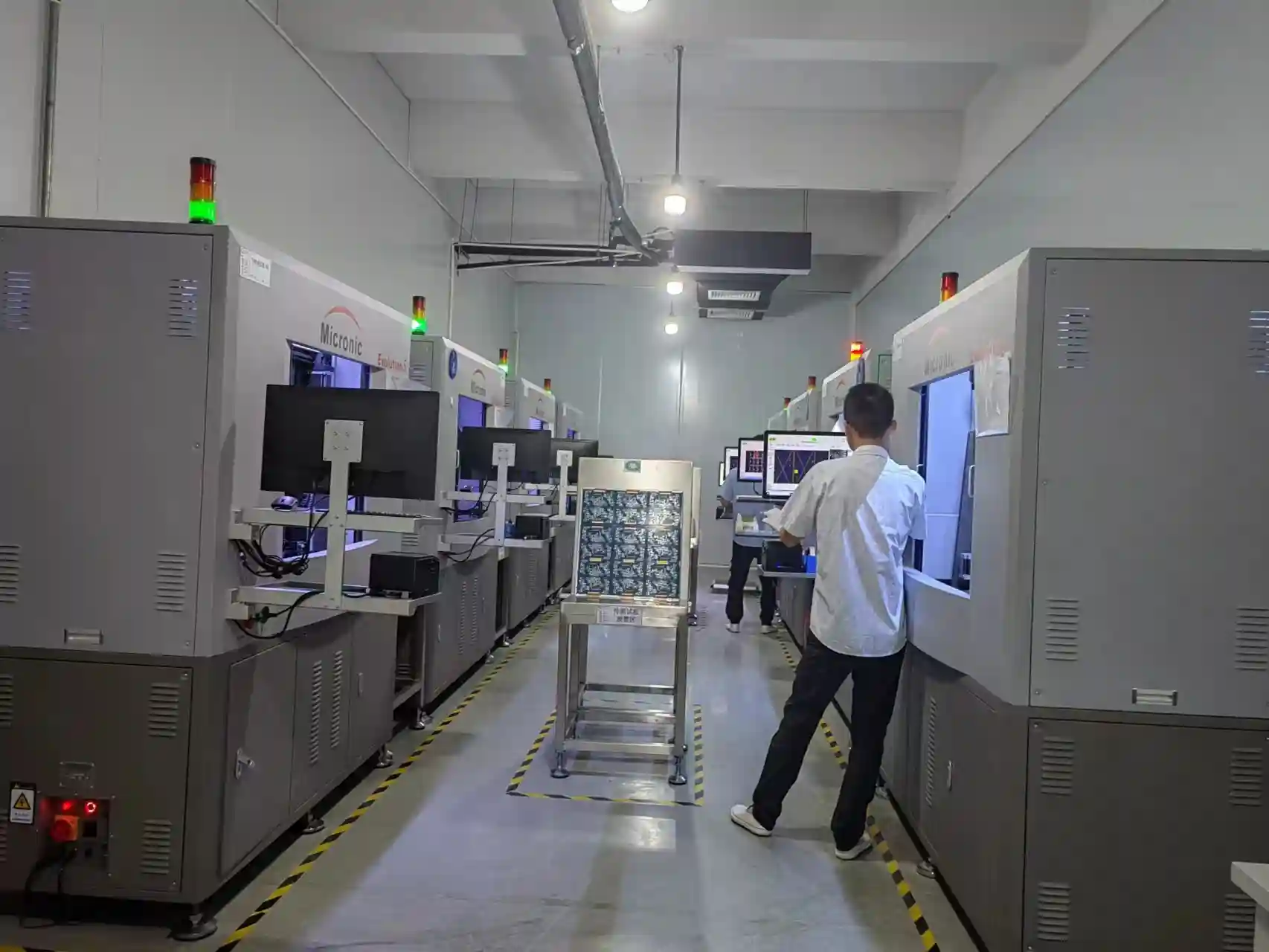
AOI Testing Guide: PCB Automated Optical Inspection Explained
Complete guide to Automated Optical Inspection (AOI) for PCB manufacturing. Learn how AOI works, defect detection capabilities, 2D vs 3D systems, and implementation best practices.
Bed of Nails Test Fixture Guide: PCB In-Circuit Testing Explained
Complete guide to bed of nails test fixtures for PCB testing. Learn about fixture types, pogo pins, ICT procedures, and quality control applications.
Double-Sided PCB: Complete Design and Manufacturing Guide
Master double-sided PCB design with our comprehensive guide covering manufacturing processes, layout strategies, via specifications, and cost optimization tips.
Ready to bring your PCB design to life?
Get an engineer-reviewed quote for your custom PCB fabrication and assembly needs.
Request a Quote